
Table of Contents
- Why You Should Verify a Gas Fitter Licence Before Work Starts
- Step 1: Check the Gas Fitter Licence Requirements in Your State
- Step 2: Run a Gas Fitter Licence Lookup on the Official Register
- Step 3: Interpret Licence Classes, Conditions and Work Scope
- Step 4: Match the Tradesperson’s Identity to the Register
- What to Do When Register Details Are Missing, Expired or Inconsistent
- Step 5: Get the Gas Compliance Certificate After the Work
- Conclusion
- Frequently Asked Questions
Last Updated: October 21, 2026
Why You Should Verify a Gas Fitter Licence Before Work Starts
A gas fitter licence is the official record that a tradesperson is legally allowed to carry out gas work in your state or territory.
At A2Z Plumbing, we hold an unrestricted plumbing contractor’s licence and a high-level gas fitter’s certification, and we expect every customer to check both. It takes about five minutes.
Here’s why that matters. Gas work is not like hanging a door. A bad connection can leak carbon monoxide, cause a fire, or void your home insurance.
Below, we walk through exactly how to verify gas fitter licence details in every state and territory, what the register results actually mean, and what to do when the record doesn’t add up.
Never accept a photo of a licence card as proof. Cards can be edited. The only reliable check is the live register run by the state or territory licensing authority, because that record updates when a licence is suspended or cancelled.
Step 1: Check the Gas Fitter Licence Requirements in Your State
Gas fitting rules sit with state and territory regulators, not one national body. So the first step is working out which authority issues the licence where you live, and what that authority actually publishes on its public register.
Each regulator keeps its own public register. Some cover plumbing and gas fitting together; others split them. Some publish conditions and endorsements openly; others show only a status line. Get this step right and the rest is quick.
| State or territory | Licensing authority | What to search | What the register typically shows |
|---|---|---|---|
| New South Wales | NSW Fair Trading | Plumbing and gas fitting licence | Licence number, holder name, class, status, conditions, expiry |
| Victoria | Victorian Building Authority | Plumbing registration and licensing | Registration number, practitioner name, category, status, disciplinary notices |
| Queensland | QBCC | Plumbing and drainage licence | Licence number, licensee name, class, status, conditions |
| Western Australia | Building and Energy (DEMIRS) | Plumbing contractor and gas fitter | Licence number, holder name, class, status, expiry |
| South Australia | Consumer and Business Services | Plumbing, gas fitting and electrical | Licence number, holder name, class, status, conditions |
| Tasmania | Consumer, Building and Occupational Services | Plumbing and gas fitting | Licence number, holder name, class, status |
| ACT | Access Canberra | Plumbing and gas fitting | Licence number, holder name, class, status, conditions |
| Northern Territory | NT WorkSafe and Building Advisory Services | Plumbing and gas fitting | Licence number, holder name, class, status |
A common mistake is searching the wrong state’s register. If your tradesperson moved from interstate, their old licence means nothing locally until it is recognised or reissued.
A second common mistake is assuming the business name on the quote is the licence holder. In several jurisdictions the register lists the individual practitioner, not the company.
Ask the tradesperson which regulator issued their licence before you search. A genuine gas fitter answers in seconds. A hesitant one is your first warning sign.
If you are unsure which authority applies, start with the regulator’s main phone line and ask them to confirm the correct register. That one call saves you from searching the wrong database and drawing a false negative.
Step 2: Run a Gas Fitter Licence Lookup on the Official Register
The gas fitter licence lookup is a free public search. You do not need an account, and you should never pay a third-party site for it.
Go straight to the regulator’s own website. Search results from directory sites and lead-generation pages are often out of date.
Searching by Licence Number vs Licence-Holder Name
Licence number search is the most accurate. The number is unique, so you get one clean result. Ask the tradesperson to text or email it to you before they arrive.
Name search is more flexible but messier. Common surnames return long lists, and spelling variations trip you up. Use the name search when you don’t have the number, then confirm the suburb and business name match.
Either way, the register should show four things:
- The licence holder’s full name
- The licence number and class
- The licence status (current, suspended or expired)
- Any conditions attached to the licence
If the register shows a business name rather than a person, check that the individual doing the work is named on that licence too.
Step 3: Interpret Licence Classes, Conditions and Work Scope
A current licence is not automatically the right licence. Gas fitting licences come in classes, and each class limits what work the holder can legally do. This is the part most guides skip, and it is the part that decides whether your job is legal.
A licence class is the category that defines the type and complexity of gas work a person is authorised to perform. A restricted licence might cover only certain appliance types or a supervised scope, while an unrestricted licence covers the full range of gas fitting work.
Reading the class against the job
Class names differ between jurisdictions, but the pattern is consistent. Most registers distinguish between:
- A contractor or business licence, authorises the business to contract for gas work. It does not, on its own, prove the individual at your door is licensed.
- An individual practitioner licence, names the person authorised to carry out the work. This is the record you match to the person on site.
- Restricted or provisional classes, limit the holder to specified appliance types, specified work, or work under supervision.
- Unrestricted classes, cover the full range of gas fitting work within that jurisdiction.
A register that shows a contractor licence but no individual name is only half the answer. Ask for the individual’s licence number and search that as well.
Reading conditions and endorsements
Conditions are the fine print that turns a valid licence into a limited one. Watch for these on the register:
- Conditions or restrictions listed against the licence, for example, work limited to certain appliance categories, or a requirement that another licensed person supervise and certify.
- Endorsements for specific work types, these extend what the holder can do, but only for the endorsed work.
- Supervision requirements, meaning someone else must sign off. If your job falls under a supervision condition, confirm who the supervisor is and that they are also licensed.
- Expiry date, and whether it falls before your job finishes. A licence that expires mid-job is a problem you want to catch before work starts.
If the register shows a condition that rules out your job, stop. Ask the tradesperson to explain it in writing before any work starts, and if the explanation does not match the register, call the regulator.
Match the licence class to the job, not just the trade. A gas fitter licensed for domestic cooktops may not be authorised for commercial or high-pressure work, and the register, not the business card, is what proves it.
When the class is unclear
Some registers use class names that do not map neatly onto the work being quoted. In that case, ask the regulator directly what the class authorises. Most contact centres will explain a class or condition in plain terms, and that answer is more reliable than any interpretation from a directory site or a competitor’s marketing page.
Step 4: Match the Tradesperson’s Identity to the Register
The licence record is only useful if the person at your door is the person named on it. This is where dodgy operators get caught out.
Call us today on 0421 799 060 →
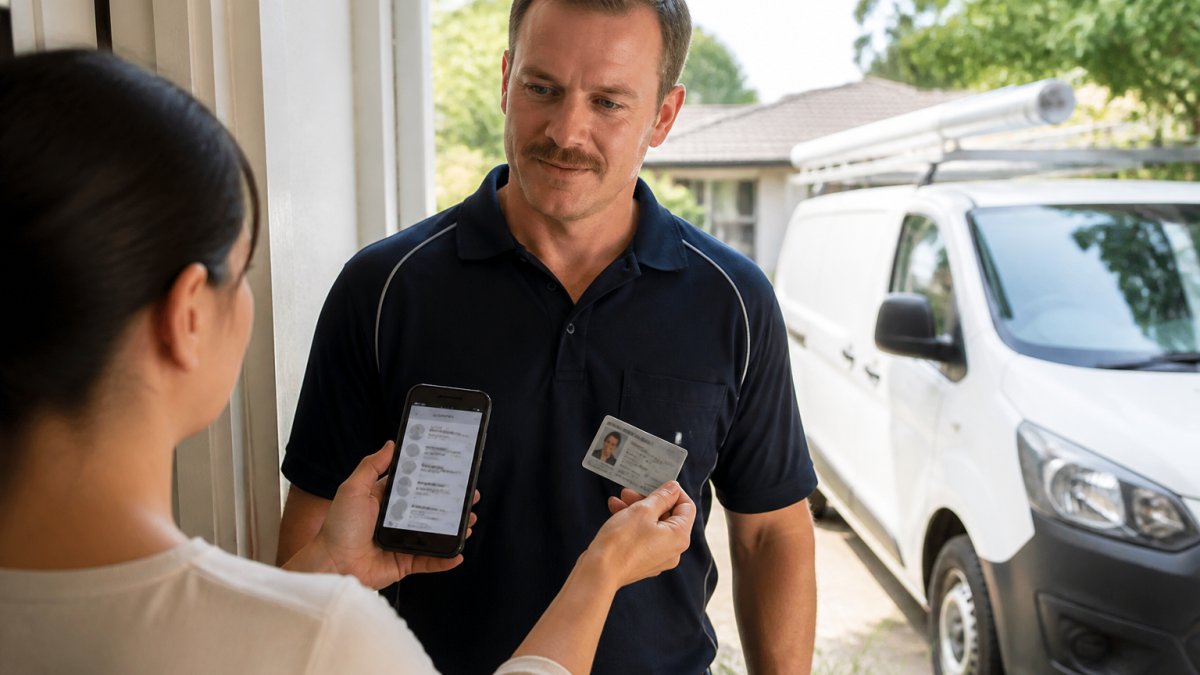
Ask to see photo identification alongside the licence card. Then compare three things against the register:
- The full name, spelled exactly
- The photo on the card
- The business name on the van or invoice
A mismatch on any of these needs an explanation. Sometimes it’s innocent, such as a subcontractor sent by a licensed contractor. But the register should still name the person holding the licence for the work.
Also confirm the business details. Ask for the ABN and check it matches the business named on the quote. A sole trader trading under a different name is a common cover story.
If you’re a property manager coordinating maintenance across multiple rentals, keep a copy of each verification on file. It protects you if a dispute arises later.
What to Do When Register Details Are Missing, Expired or Inconsistent
A missing or expired record is not always fraud. Registers have data entry gaps, and licences lapse. But you should not let work proceed until it’s sorted.
Here’s how we’d handle each situation:
Licence shows as expired. Ask the tradesperson to renew before starting. If they can’t, find someone else. An expired licence means no insurance cover for gas work.
No record found. Ask for the exact spelling and licence number again, then re-search. If it still returns nothing, walk away.
Name doesn’t match. Request the licence holder’s details in writing. If a subcontractor is doing the work, the licensed contractor must confirm it in writing.
Conditions you don’t understand. Call the regulator directly. Their contact centre will explain what a condition means in plain terms.
Pressure to skip the check. This is the biggest red flag. A licensed gas fitter will happily wait two minutes while you search.
If someone refuses a licence check or offers a cash discount to skip paperwork, that is licence fraud territory. Report it to your state regulator and do not let them start work.
Step 5: Get the Gas Compliance Certificate After the Work
The job isn’t finished when the tools are packed away. You need a gas compliance certificate.
A gas compliance certificate is the official document confirming that gas work was carried out to the required standard by a licensed person. It protects you, your insurer and anyone who later buys the property.
Ask for it before you pay the final invoice. Check that it names:
- The licensed gas fitter who did the work
- The licence number
- The address and the work performed
- The date and the certifying authority
Keep the certificate with your property records. If you ever sell, rent out the property, or make an insurance claim related to gas, this document is what proves the work was legal.
If the certificate never arrives, follow up in writing. A legitimate operator will send it. If they don’t, contact the regulator.
Conclusion
Verifying a gas fitter licence takes five minutes and protects your home, your insurance and your family. Check the regulator’s register, match the identity, read the conditions, and insist on a compliance certificate.
At A2Z Plumbing, every job is carried out under an unrestricted plumbing contractor’s licence and the highest level of gas fitter’s certification. We’re a family-owned business, a member of Master Plumbers, and we back all work with a guarantee. Call us today on 0421 799 060 to book a licensed gas fitter who’s happy to show their credentials before they start.
Frequently Asked Questions
How can I check a gas fitter’s licence online?
Go to the licensing authority’s public register for your state or territory and search by licence number or licence-holder name. Enter the number exactly as shown on the card, then confirm the name, licence class, status and expiry match. A current licence should show as active with no conditions that exclude the work you need. If the register returns no result, ask the tradesperson for their licence number again before booking.
What details do I need to check a gas fitter’s licence?
You need the licence number and the licence-holder’s full name as they appear on the card. The register will then show the licence class, status, expiry date and any conditions. Ask for the business name and ABN too, so you can confirm the entity quoting is the same one holding the licence. A photo ID check on the day adds a final layer of confirmation.
What should I do if I cannot find a gas fitter on the licence register?
Do not book the work until the discrepancy is resolved. Ask the tradesperson to show their physical licence card and confirm the exact spelling of their name and number. Registers sometimes list a former name or a business trading name, so try those variations. If nothing matches, contact the state licensing authority directly. An unlisted operator may be unlicensed, and gas work carries real safety and insurance risks.
Why does a gas compliance certificate matter after the work?
A gas compliance certificate is the record that the gas fitting work was done to the required standard by a licensed person. It matters for insurance claims, property sales and rental compliance. Ask for the certificate before paying the final invoice, check that the licence number on it matches the one you verified, and keep it with your property records. Without it, proving the work was compliant later becomes difficult.