
Quick Summary
The most common signs of hot water system failure are leaks around the tank, pipes and valves, rusty or discoloured water, and lukewarm or inconsistent hot water. Rumbling or banging noises and a system past its expected service life also signal trouble. Catching these early often allows a small repair instead of an emergency replacement.
- Check the base of the unit, pipe connections and pressure relief valve for damp patches or drips.
- Rust-coloured water is a primary indicator that the anode rod has been used up.
- Storage electric tanks typically last around 10 to 15 years, often less in areas with hard water.
- Do not tighten or repair a leaking valve yourself, as a faulty valve can build pressure.
- Replace the unit if the tank is leaking or rusting internally, or repairs keep happening every few months.
Table of Contents
- Why Early Warning Signs Matter for Your Hot Water System
- Leaks Around the Tank, Pipes and Valves
- Rusty, Discoloured or Smelly Hot Water
- Hot Water System Troubleshooting: Symptom-to-Cause Checks
- How Long a Hot Water System Lasts and When Age Becomes the Problem
- Hot Water System Repair or Replacement: Decision Framework
- Booking a Licensed Plumber to Check Your Hot Water System
- Frequently Asked Questions
Why Early Warning Signs Matter for Your Hot Water System
Last Updated: November 12, 2026
Most hot water systems fail with little warning in the moment, but the signs usually show up well before the tank gives out. A2Z Plumbing has put together this guide to help Perth homeowners spot the early signs of hot water system failure and decide what to do next. Catching a problem early can mean a small repair instead of an emergency replacement at 11 PM.
Water heater failures are rarely random. Based on Rapid Eye Inspections’ breakdown of water heater failure modes, 69% of failures are caused by a leak in the unit or a burst tank. Another 13% come from valve malfunctions, and 10% from supply line failure. That means most of the problems that cause a failure can be spotted early.
Here is what this guide covers:
- Leaks around the tank, pipes and valves
- Rusty, discoloured or smelly water
- Lukewarm or inconsistent hot water
- Rumbling, banging and other noises
- System age and when replacement makes sense
- Repair or replace, and when to call a licensed plumber
Share of water heater failures by cause
Leaks Around the Tank, Pipes and Valves
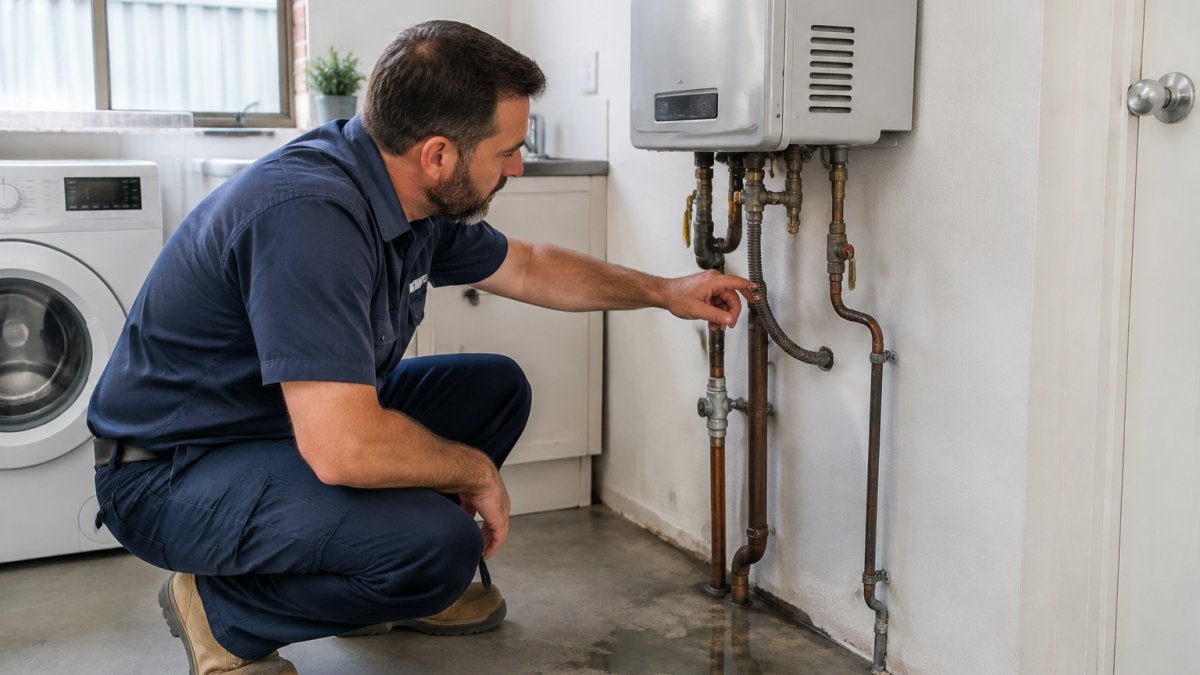
Leaks are the most common reason hot water systems fail. Check the base of the unit, the pipe connections and the temperature and pressure relief valve for any sign of water. A damp patch, drips or a small puddle under the unit all count.
Look for these signs:
- Water pooling under the tank
- Rust or mineral crust around fittings
- Drips from the pressure relief valve
- Damp walls or flooring near the unit
Some leaks are easy to see. Others hide behind cupboards or in ceiling spaces. If your water bill has gone up without any change in use, a hidden leak could be the cause.
Watch out: Do not tighten or try to repair a leaking valve yourself. A faulty valve can build pressure, so have a licensed plumber look at it straight away.
Rusty, Discoloured or Smelly Hot Water
Discoloured water is one of the clearest warning signs. A. O. Smith’s guidance on anode rods notes that rust-coloured water is a primary indicator that the anode rod has been used up, which can lead to tank failure through electrolysis. Because rust-coloured water can signal that corrosion has reached the tank, troubleshooting steps for water heaters can help distinguish a repairable fault from a system nearing failure.
Check the colour and smell of your hot water:
- Rusty or brown water: Often points to internal corrosion in the tank.
- Metallic or bitter taste: Can mean corrosion or water quality problems.
- Rotten egg smell: May point to bacteria growing in the tank.
Run a tap for a few minutes. If the colour clears but comes back when the hot water runs, the problem is likely inside the tank.
Hot Water System Troubleshooting: Symptom-to-Cause Checks
Use this guide to match what you notice with the likely cause, how urgent it is, and what you can safely do before a plumber arrives. It does not replace a proper inspection, and it deliberately separates safe homeowner checks from work that must be done by a licensed professional.
| Symptom | Likely cause | Urgency | Safe next step |
|---|---|---|---|
| Water pooling at the base of the tank | Tank corrosion or a failed fitting | Emergency, same day | If safe, turn off the cold inlet and the power or gas supply, then call a licensed plumber |
| Rust-coloured or brown hot water | Depleted anode rod or internal corrosion | Book within days | Run the tap briefly to confirm it clears, then arrange an inspection |
| Rotten-egg smell in hot water only | Bacteria in the tank, often with a failing anode | Book within days | Do not drink the water; arrange a service |
| Dripping from the temperature and pressure relief valve | Faulty valve or excess pressure | Prompt, within 24 hours | Do not cap or tighten the valve; call a plumber |
| Banging, rumbling or popping | Sediment build-up on the heating element or tank base | Service soon | Note when it happens; arrange a flush |
| Lukewarm water from a storage tank | Failed element, thermostat or dip tube | Prompt | Check the thermostat setting is sensible, then call a plumber |
| Hot water runs out much sooner than usual | Sediment, a failing element, or a smaller-than-needed tank | Book within days | Compare against your normal household use before booking |
| Continuous-flow unit delivers cold or fluctuating water | Ignition, sensor or flow fault | Prompt | Check the unit is powered and the display shows no error code, then call a plumber |
| Hissing near the unit or a gas smell | Gas or pressure fault | Emergency, immediately | Do not switch anything on or off; leave the area and call your gas supplier or emergency services |
| Scalding or wildly fluctuating temperature | Thermostat, mixing valve or element fault | Prompt | Stop using the hot tap and arrange an inspection |
A few patterns are worth knowing because they change the diagnosis:
- Storage tanks tend to fail from the inside out. Rusty water, rumbling and a damp base usually point to corrosion or sediment, and a tank that is leaking from the shell is generally beyond repair.
- Continuous-flow systems have no tank to corrode, so the usual suspects are ignition, sensors, water flow and scale. Error codes on the display are the fastest clue.
- Heat-pump systems can show a different pattern again, a tripped circuit, a fan fault or a refrigerant issue can all present as “no hot water” without any leak or noise.
Watch out: Never open the cover of a gas or electrical unit, and never attempt to reseat a relief valve or reset a safety switch you do not understand. Gas, electrical work and pressure vessels should be handled by a licensed professional.
How Long a Hot Water System Lasts and When Age Becomes the Problem
Age is one of the strongest predictors of failure, but “old” means different things for different systems. As a rough guide, typical service life is often expected to be:
- Electric storage tanks: around 10 to 15 years, often less in areas with hard water.
- Gas storage tanks: similar to electric, with the added wear of a burner and flue.
- Continuous-flow (instantaneous) units: often 15 to 20 years with regular servicing, because there is no tank to corrode.
- Heat-pump systems: commonly 10 to 15 years, depending on compressor and fan wear.
These are typical ranges, not guarantees. A well-maintained unit can outlast them, and a poorly maintained one can fail well before.
How to find your unit’s age. Look for the manufacturer’s data plate on the side of the tank or under the cover of a continuous-flow unit, which usually shows a serial number and a manufacture date. Write the date down and keep it with your household records.
Why age changes the decision. Once a system is past its expected service life, three things happen at once:
- Failures become more frequent. Components wear together, so fixing one part often reveals the next weak point.
- Repairs cost more relative to value. A repair bill on a 14-year-old tank buys less remaining life than the same bill on a 6-year-old unit.
- Efficiency drops. Older units, particularly electric storage tanks, often cost more to run than a modern equivalent, so the running-cost saving partly offsets the replacement price.
A useful rule of thumb: if the unit is past its expected life and the repair is more than a minor component, replacement often makes more sense than repair. If it is well within its life and the fault is isolated, repair is often the better option.
Watch out: A tank that looks fine from the outside can still be close to failure. Internal corrosion often develops silently until the shell gives way, which is why a leaking tank is rarely worth repairing, by the time water appears, the steel is already compromised.
Hot Water System Repair or Replacement: Decision Framework
Use this simple framework to decide what to do:
- Repair if the fault is isolated, such as a single element, thermostat or valve, and the tank is in good condition.
- Replace if the tank is leaking, rusting internally, or close to the end of its service life.
- Replace if repairs keep happening every few months.
If you are unsure, a licensed plumber can inspect the unit and give you a clear recommendation. Pricing depends on the system type, its location and the work needed, so ask for a written quote before any job starts. You can see typical hot water system replacement costs before you decide. Current prices are available on our website or by requesting a quote. Browse our hot water system services to see what we can help with.
Booking a Licensed Plumber to Check Your Hot Water System
Some checks are safe for homeowners. Looking for leaks, checking the water colour and reading the thermostat are all fine. Anything involving gas fittings, electrical work, the pressure relief valve or tank removal needs a licensed professional.
If you have a leak, no hot water, or a gas smell, act now. Turn off the power or gas supply and call for help straight away. For urgent help, our emergency plumber in Perth service is available around the clock. You can also read our emergency plumber rates before booking.
When you book, ask the plumber to:
- Inspect the tank, valves and connections
- Check the anode rod and internal condition
- Explain the repair options and provide a written quote
For routine hot water and plumbing work, see our plumber in Joondalup page. A2Z Plumbing is a family-owned business with an unrestricted plumbing contractor’s licence and high-level gas fitter’s licence. Call us on 0421 799 060 for a quote.
Frequently Asked Questions
What are the common signs of hot water system failure?
The most common signs are water leaking around the tank, pipes or valves, rusty, discoloured or smelly hot water, lukewarm or inconsistent temperatures, running out of hot water sooner than usual, and rumbling or banging noises from the unit. Leaks and burst tanks are among the most common causes of water heater failure, which is why any visible water around the unit deserves prompt attention. If you notice more than one of these signs together, arrange an inspection rather than waiting for a complete failure.
Can a leaking hot water system be repaired?
Sometimes. A leaking fitting, valve or supply line can often be repaired or replaced at a reasonable cost. A leak from the tank body itself usually means the tank has corroded or cracked, and in that case replacement is generally the safer option. A licensed plumber can tell the difference during an inspection. Do not ignore a leak, because water damage to flooring and cabinetry can add significantly to the total cost of the problem.
Why is my hot water system making unusual noises?
Rumbling or banging is most often caused by sediment building up at the bottom of the tank, which traps heat and causes boiling pockets of water. Over time this stresses the tank and can accelerate corrosion. Some flushing and maintenance can reduce sediment, but persistent noise is worth having checked by a licensed plumber, as it can also indicate a failing element or valve.
